On Stewardship, Assets, and Responsibility
Much of the contemporary language around sustainability assumes that systems designed to extract value can become sustainable in the same way that natural systems are self-sustaining. This assumption is rarely examined, yet it underpins corporate reporting, regulatory positioning, and institutional narratives.
Natural systems regenerate within ecological limits. Institutions do not.
Institutions are structured to convert, concentrate, and distribute value. In doing so, they draw upon environmental, economic, social, and cultural assets that they neither fully regenerate nor permanently retain. This is not a moral failure. It is a structural condition.
If extraction is structural, then the question is not whether institutions can become sustainable in a natural sense. The question is how responsibility for the value-creating assets they rely upon is governed across time, proximity, and consequence.
This publication forms part of an ongoing inquiry into Concentric Stewardship™, a discipline concerned with the governance of value-creating assets across environmental, economic, social, and cultural domains.
The term asset remains deliberate. Assets are not limited to physical materials or financial instruments. They include ecosystems, human capacity, institutional credibility, social trust, and cultural meaning. Each generates value. Each can be depleted. Few are governed beyond primary use.
Post-use is where responsibility most often dissolves. Institutions govern procurement and performance, yet rarely govern transition. Once an asset has served its immediate purpose, it is transferred, exported, discarded, or absorbed into opaque downstream systems. The costs of that transition are frequently externalised geographically, economically, or socially, which reflects a broader tendency to treat the end of primary utility as the end of responsibility.
Concentric Stewardship approaches responsibility differently. Stewardship is not an identity or a declaration of virtue. It is a governance function. It establishes custody without ownership, continuity without possession, and accountability beyond immediate use.
The term concentric reflects the layered nature of responsibility. Duties are not circular in the abstract. They move across domains and proximities. Those closest to an asset exercise direct control. Those further removed participate through design, financing, regulation, consumption, or cultural reinforcement. Responsibility does not disappear as distance increases. It changes form.
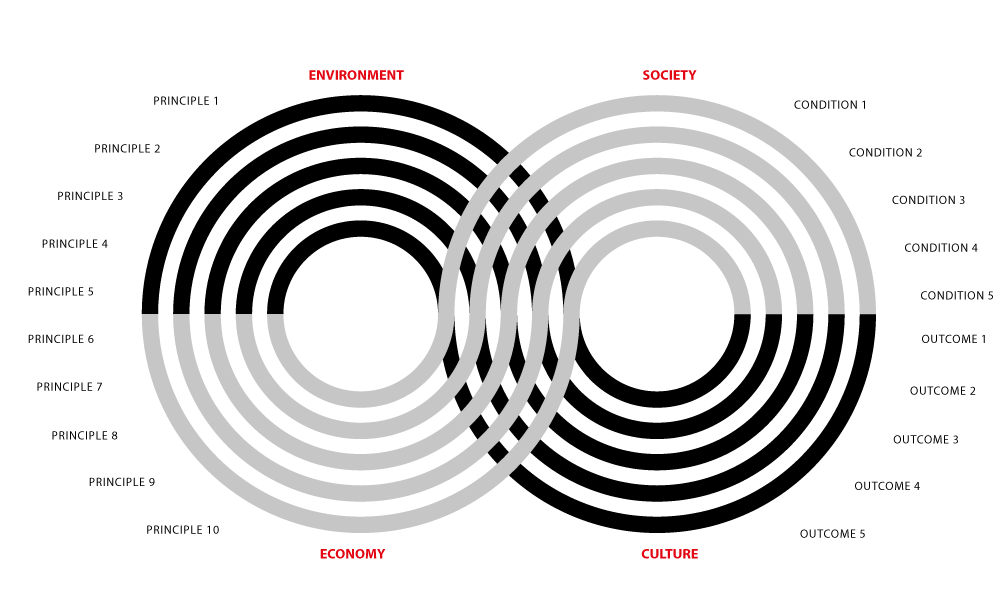
Within this framing, reparative responsibility is not rhetorical. Where damage or depletion has occurred, the cost of correction should not be displaced onto the least resourced actors in the system. Responsibility follows capacity and contribution.
This discipline does not reject commerce or institutional function. It seeks to govern them more coherently. Governance replaces aspiration. Documentation replaces assumption. Transition is treated as deliberately as acquisition.
Applications such as The Decade Water Compact and The Cooperative Loop as well as its Marvarzi™ counterpart operate within this logic. They are not sustainability initiatives. They are mechanisms for governing responsible return, transition and the retention of value beyond primary use.
This space remains exploratory. Definitions will continue to sharpen. Boundaries will be tested. Some conclusions may remain provisional.
This is not a manifesto. It is an inquiry into how assets move, how value persists or dissipates, and how responsibility can be structured rather than declared.
Yessey Rayar is the originator of the Concentric Stewardship™ framework